
Home » 2020
Yearly Archives: 2020

Book on US-War Narratives, Trauma, and Indigenous Military Traditions Now on Open Access

My second monograph, titled Ceremonial Storytelling: Ritual and Narrative in Post-9/11 US Wars, has been out since early 2019. A few days ago, the term of copyright restrictions has run out and, under the “green rule” of open access publishing, the book can now be accessed online and free of charge.
The book can be downloaded here:
https://www.peterlang.com/view/title/65336?format=EPDF
Here is a quick abstract from the back cover:
“US society has controversially debated civil-military relationships and war trauma since the Vietnam War. Civic activists today promote Indigenous warrior traditions as role models for non-Native veteran reintegration and health care. They particularly stress the role of ritual and narrative for civil-military negotiations of war experience and for trauma therapy. Applying a cultural-comparative lens, this book reads non-Native soldiers’ and veterans’ life writing from post-9/11 wars as «ceremonial storytelling.» It analyzes activist academic texts, «milblogs» written in the war zone, as well as «homecoming scenarios.» Soldiers’ and veterans’ interactions with civilians constitute jointly constructed, narrative civic rituals that discuss the meaning of war experience and homecoming.”
The work largely follows a cultural-studies approach with forays into Indigenous studies, (new) media studies, and psychology, as well as tying in aspects of various fields of history. As such, it also reflects on the role of digital media for future historical research.
The book is organized into four major chapters: “Narrating War: Activist Discourse and Cultural Comparison” observes how segments of the US public, particularly veterans-affairs activists and mental health specialists, discuss veteran reintegration and war trauma from a community-oriented perspective, arguing that US society should learn from close-knit communities, to provide social support for veterans and trauma survivors. They often cite Native American military traditions, especially the fact that contemporary Indigenous veterans seem to have a better chance to cope with PTSD when undergoing traditional war-related ceremonies in their communities.
The following chapter, “Milblogs as Rituals: War, Citizenship, and the Sacred“, investigates how blogs written by non-Native soldiers from the combat zone can be understood as contemporary (secular) war rituals. It argues that the blogs’ audience actively participates to the blogs and, thus, that the sequencing of posts and comments denotes a civic ritual of discussing war experience in a public forum.
In the chapter “Beyond the Call of Duty: War Experience, Relationship-Building, and Community Service,” I argue that milbloggers understand their writing as an additional form of service to their communities (e.g., how-to advice for fellow and future soldiers, or a notion of “what it’s like out there” for civilians). The chapter discusses how such a sense of service can work as ‘help to help yourself’ and can therefore be seen as a form of working through, possibly even overcoming, traumatic experience.
The final chapter, “Singing their ‘Song’: Veterans, Civilians, and the Trials of Homecoming,” asks how veterans deal with war experience after their return. Only a few of the many soldiers who blogged from deployment continue to blog once back home. This chapter, therefore, looks into other forms of narrative self-expression, such as creative writing workshops, veteran lecture projects, documentaries, and theater. This chapter also goes beyond the many references to Native American war-related traditions that are currently used by activists and psychologists, and includes the popular references to classical Greek tragedy. Many of these ancient texts were written and performed by war veterans and detail the challenges of returning home from war. Reference to these classics has been a popular form of civic engagement and professional health care regarding veterans.

“Posted!” Exhibition Presents North American Indigenous Posters
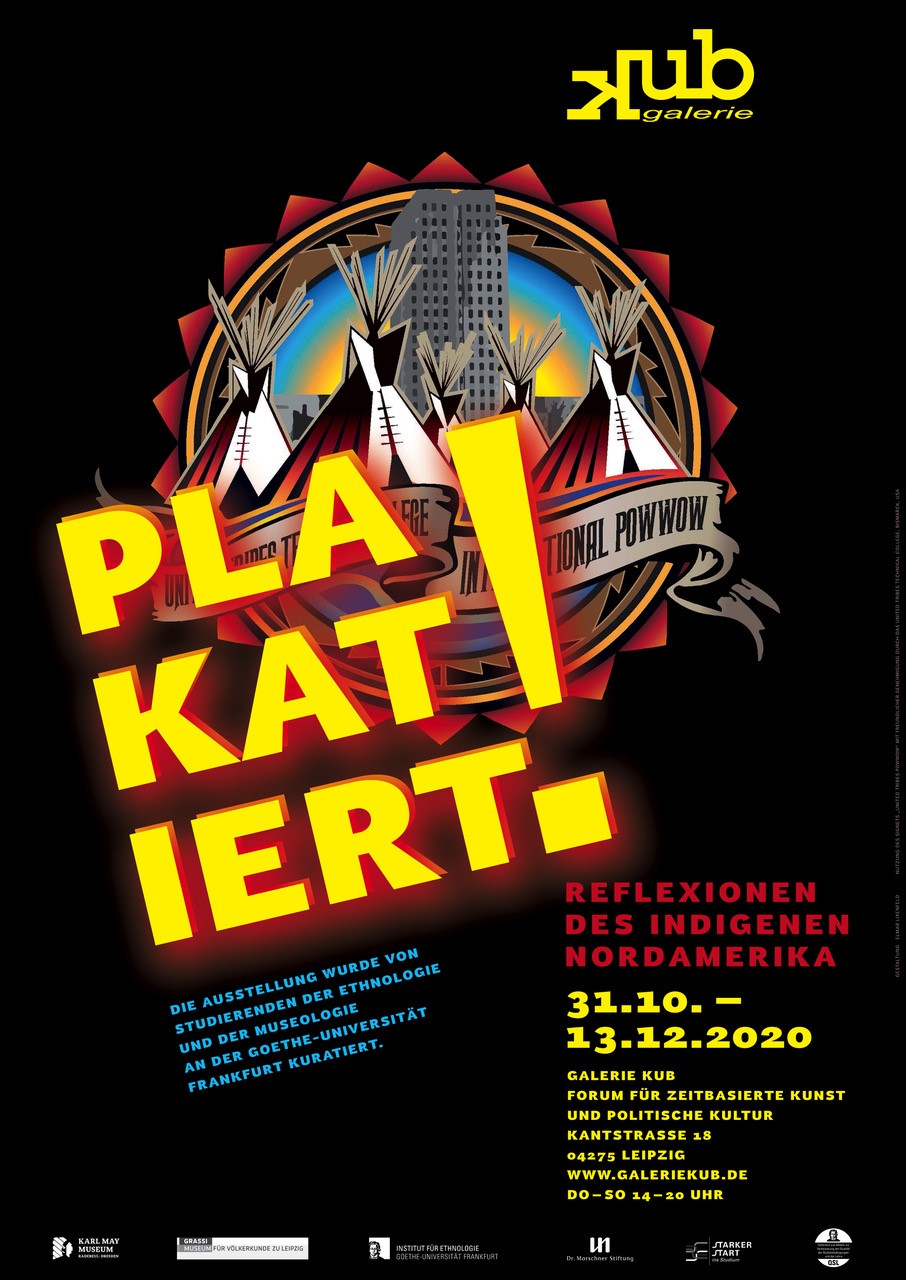
A few days prior to the newest Covid “mini”-lockdown, we opened a new exhibition. The show “Posted! Reflections of Indigenous North America” is hosted by galerie KUB and jointly organized by Grassi Museum / State Ethnographic Collections Saxony and Karl-May-Museum Radebeul. The exhibit was designed by students of Ethnology and Curatorial Studies at Goethe University Frankfurt/Main. It presents posters from the US and Canada, either made by/for Indigenous communities, or directed at them, covering the period from the 1970s until today. The topics range from election posters, powwow and art show posters, to posters from information campaigns on public health, social issues, or the US census.
Here are links to the original exhibit at the Weltkulturenmuseum Frankfurt on Instagram and Facebook.
We are glad about this project for several reasons. We wanted to increase our collaboration with universities and give students better access to practical work at the museum. “Posted!” not only helps give the Frankfurt students’ work better visibility, it also helps us devise our own student projects. This leads to the next factor: As we are working to improve our museums’ networks with civil society and players in local culture, the arts, and civic engagement, working with galerie KUB helps prepare the ground for future projects with students and civil associations.
The current lockdown put events around the show on hold, but we have already started a school project with an English course at the nearby Kant Gymnasium high school that will interpret the posters and develop their own presentations on topics discussed in the show. Once the lockdown is lifted, we also hope to provide guided tours that had to be postponed for now. The tours will offer general information on Indigenous North America and on the exhibit, but there are also special themes, such as Indigenous politics and the 2020 presidential election in the US, or social issues, public health, and the Covid crisis.
The exhibition will be extended into January 2021. Exact dates will be provided soon at our Grassi museum program website and at the site of galerie KUB.
Talking about Repatriation and Restitution
Our Leipzig site, the Grassi Museum für Völkerkunde, recently held a podium discussion in a new event series titled “Decolonize.” The evening’s theme was “Decolonize: Restitute and Repatriate”. Our curator for Australia and the Pacific and Chief of Provenance Research and Restitution, Birgit Scheps-Bretschneider, discussed the repatriations of human remains our institution, the State Ethnographic Collections Saxony (SES) organized since 2017. Our museums returned human remains to Hawai’i (2017) and to several Australian communities (2019). We currently are in negotiations about further repatriations to New Zealand, Namibia, and North America.
During the evening, Birgit Scheps-Bretschneider pointed out that repatriations require much, and often lengthy, preparations (negotiations with government institutions, provenance research, forensic studies, discussions with source communities). Ideally, the return is part of a collaboration between source communities and museums. In the case of our Australian repatriations, our colleagues have participated in language revitalization projects that evolved out of repatriation negotiations, and our institution will contribute to the construction of a final resting place and community memorial for the returned ancestors.
We also had the opportunity to discuss emerging projects, such as our involvement in the “Labrador Avertok Archaeology Project”: SES was approached by colleagues from Memorial University of Newfoundland who work with Inuit communities in Labrador, i.e., the autonomous region of Nunatsiavut. We hosted visitors last fall who documented objects from the region in our collection and took 3D scans of some objects. These scans will be fed into a database at Inuit community centers in Labrador. Young community members will build and maintain the database and teach community elders how to use the technology. In return, the elders will use the documented images from our collections to teach young people about old cultural techniques, such as stitching patterns, basketry, or ivory carving. Such efforts in “immaterial restitution” also contribute to decolonization work at museums.
The Covid crisis has put many scheduled projects on hold (visits by and at communities), but the work continues and we are preparing more visits and repatriations for a time when travel will be, once again, possible.
 frankusbeck