
Home » 2018
Yearly Archives: 2018
Publications on Veterans, Volunteerism, and Writing
I’m glad to announce that two articles from my research on veterans and war narratives have been released recently. This work is part of the larger research initiative “Selbst-Bewusste Erzählungen” on the interrelations of textuality and social relevance in contemporary US literature and culture, originated as a research collaboration between TU Dresden and Leipzig University.
One article, “’To Put Others Before Yourself’: Volunteerism and Mental Health in US Veterans’ Projects,” discusses two NGOs organized by and for veterans to analyze how their activism responds to the sense of social crisis prevalent in these public debates on veterans’ affairs (The Mission Continues and Team Rubicon). It presents the projects’ online self-representation and their documentation in activist scholarship and journalism to carve out how civic engagement in veterans’ affairs challenges the traditional myth of American individualism to promote volunteerism and community service as vehicles for reintegration, promoting – and enacting – the civil-military social contract.
The other article, “’Writing Yourself Home’: US Veterans, Creative Writing, and Social Activism” explores how public discourse about civil-military relationships, war experience, and trauma, simmering since the domestic divisions over Vietnam, turned to first-person narratives in recent years to discuss the psychological costs of war and homecoming. It interprets the proliferation of veterans’ writing projects as part of a civic activist movement that seeks to address veterans’ social and emotional struggles through community (re)building and social therapy. The writing projects promote themselves as a means to bridge the experiential gap between civilians and veterans and, in doing so, they enact social reintegration.
The manuscript for the project’s main publication, my second monograph Ceremonial Storytelling. Ritual and Narrative in Post-9/11 Wars, was recently submitted to Peter Lang Publishing and will be released in their American Culture series.
“Indians Couldn’t Stop Immigration” (IV): New Article in a Conference Collection
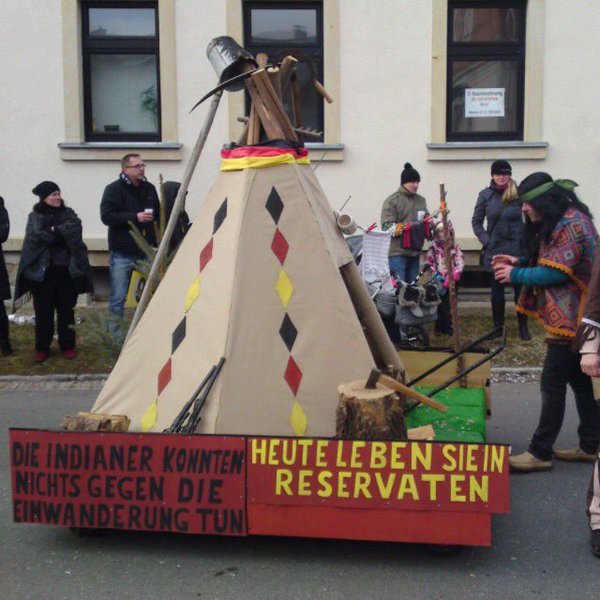
‘Indigenous’ culture in Germany, under threat from invaders disguised as refugees – float at a carnival procession in Altenberg, Saxony, 2016. The caption reads “Indians Couldn’t Stop Immigration. Now they Live on Reservations”
In May 2015, I attended a conference on the history of German perceptions of the US since 1945 in Tutzing. My presentation explored how nationalist and racist tropes of the Nazi era utilized Native American imagery and historical comparison, and how these arguments were adapted among neo-Nazis and right-wing populists in Germany to stoke nativist sentiment during the current refugee crisis. In the following months, I developed a series of blog posts on this issue:
Earlier this month, my colleague Volker Benkert published the German-language conference collection, titled Feinde, Freunde, Fremde?…. My contribution further develops ideas laid out in these early blog posts. Other contributions cover transatlantic comparative analyses of genocide, German-American cultural transfer, perspectives on the US in East and West Germany during the Cold War, and German-American relations until today.
Initially, I had intended the series on Indian imagery in German nativism and immigration on this blog to be a minor spin-off following my dissertation research. Recent events, such as the growing influx of refugees since 2014, the rise of nationalist, nativist, and racist political organizations, and their increasing visibility in public discourse, however, merit more deeper explorations of the issue. It seems that protagonists in these public debates not only recycle Indian imagery and argumentation from the Nazi era, but that growing exchange and interrelation among similar political currents across Europe also shares and disseminates related imagery, such as references to Native Americans and Indigeneity.
 frankusbeck